
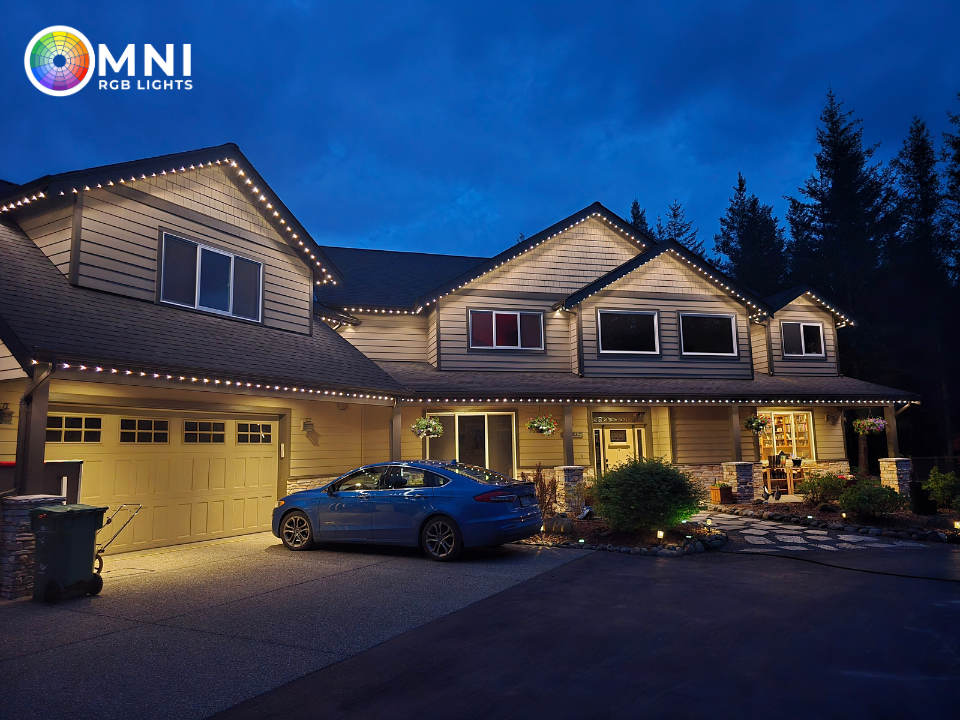
On Sunday, November 1, the clocks fall back an hour, and suddenly it’s dark before most people pull into the driveway after work. That’s when the gaps in a home’s outdoor lighting show up: the unlit step, the pitch-black side yard, the house number nobody can read from the street.
The short version: Light the places people walk and the places someone could hide: entries, steps, walkways, the driveway, and your house number. Aim fixtures down, use warm light, and put everything on a sensor or timer so it’s on when you need it and off when you don’t.
Why the time change matters more than you’d think
From early November through February, a lot of daily life happens in the dark. Coming home, walking the dog, rolling the trash can to the curb, carrying groceries from the car. Steps and walkways that feel fine at noon turn into trip hazards at 6 p.m., and a dark front porch makes it hard to see who’s knocking.
Where outdoor lighting does the most good
- Entries and porches. So you can find the lock and see who’s at the door.
- Steps and walkways. One unlit step causes more trouble than a dark lawn ever will.
- Driveway and garage. Where your hands are full and you aren’t looking down.
- Side yards and back doors. The spots that are dark and out of view from the street.
- House numbers. If an ambulance or delivery driver can’t read your number at night, it isn’t doing its job. 🏠
How we plan lighting (and how you can, too)
When we look at a property’s lighting, we do it at dusk, not at noon. We walk the path a guest would take from the curb to the front door, then the path you take from the car, and note every spot where you’d want a flashlight. That list becomes the plan.
Then we think about control. Dusk-to-dawn sensors work well for the entry. Motion sensors make sense for side yards and back doors. Timers or an app handle the rest, so nothing burns all night for no reason.
Brighter isn’t always better
It’s tempting to fix a dark yard with one big floodlight. The trouble is glare. A harsh light pointed outward makes it harder to see past it, bothers the neighbors, and leaves deep shadows right beside it. DarkSky International’s Five Principles for Responsible Outdoor Lighting sum up a better approach: light should be useful, targeted, no brighter than needed, controlled, and warm in color.
In practice, that means fixtures aimed down at what you actually need to see, and bulbs in the warm-white range, around 3000K or lower, instead of blue-white glare.
Helpful resources
- DarkSky International: Five Principles for Responsible Outdoor Lighting
- DarkSky International: Home Outdoor Lighting Assessment, a quick self-check for your own yard
Want help lighting it right? 💡
G&H now designs and installs landscape and pathway lighting, planned around how you actually use your home after dark. Request a free quote or call 704-946-7659.
Frequently asked questions
When does daylight saving time end in 2026?
Sunday, November 1, 2026, at 2 a.m. Clocks fall back one hour, so evenings get dark about an hour earlier.
What color outdoor light is best?
Warm white, around 3000K or lower. It’s easier on the eyes, cuts glare, and is the range DarkSky International recommends for responsible outdoor lighting.
Do motion-sensor lights help with security?
They help. A light that switches on with movement draws attention to the spot and avoids lighting an empty yard all night. Paired with a security camera, it also gives you clearer video.
How bright should walkway lights be?
Bright enough to see the edge of every step, not bright enough to light the whole yard. Several low fixtures spaced along a path usually work better than one bright floodlight.